Ohm's Law Explained: A Guide to Understanding Ohmic Resistance
* Question

Ohmic resistance function

* Answer

Ohmic resistance refers to the resistance offered by a material to the flow of electric current,
which follows Ohm’s Law. The relationship between the current I, voltage V, and resistance R is
given by:

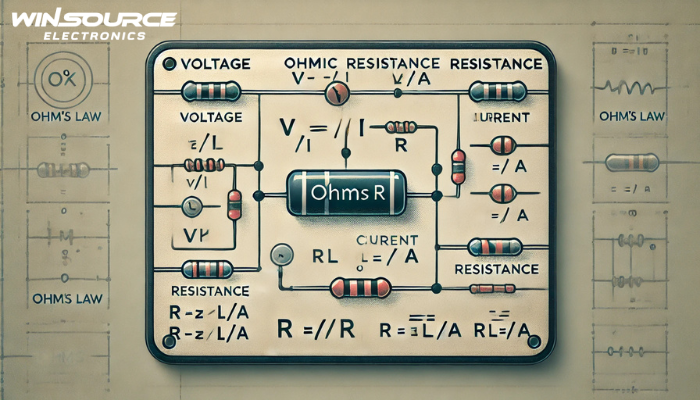
R = V/I

This equation defines the Ohmic resistance function, which applies to materials where the
resistance remains constant as the voltage and current change, following a linear relationship.

Key Points:
– Ohmic materials like most metals exhibit a direct proportionality between voltage and current,
meaning they follow Ohm’s Law.
– Non-Ohmic materials do not have a constant resistance, and the relationship between voltage
and current is non-linear.

In practical applications, Ohmic resistance is influenced by factors such as temperature, material
properties, and dimensions of the conductor. The resistance R can also be expressed as:

R =ρ*L/A

Where:
– ρ = Resistivity of the material dependent on the material and temperature
– L = Length of the conductor
– A = Cross-sectional area of the conductor

This is the basic function of Ohmic resistance in electrical circuits.

Frequently Asked Questions

Q: What is Ohm's Law Explained: A Guide to Understanding Ohmic Resistance?
A: Understanding Ohm's Law and Ohmic resistance: Learn about the relationship between current, voltage, and resistance in electric circuits.
Q: Which category does Ohm's Law Explained: A Guide to Understanding Ohmic Resistance belong to?
A: Ohm's Law Explained: A Guide to Understanding Ohmic Resistance is part of our QUESTIONS & ANSWERS collection, where we cover the latest trends and technical insights.
Q: Where can I find more technical details on QUESTIONS & ANSWERS?
A: You can explore our QUESTIONS & ANSWERS section for more articles and resources related to this topic.