Data Processing Instructions Overview for ARM Processors
* Question

What types of ARM data processing instructions are there?

* Answer

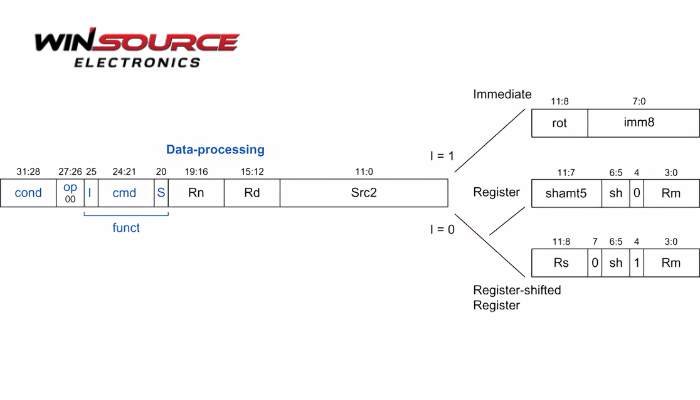
ARM processors support a variety of data processing instructions, which perform operations on registers and immediate values. These instructions can be categorized into the following types:

1. Arithmetic Instructions

These perform basic arithmetic operations:

  • ADD– Addition (Rd = Rn + Operand2)
  • ADC– Addition with carry (Rd = Rn + Operand2 + Carry)
  • SUB– Subtraction (Rd = Rn – Operand2)
  • SBC– Subtraction with carry (Rd = Rn – Operand2 – NOT Carry)
  • RSB– Reverse subtract (Rd = Operand2 – Rn)
  • RSC– Reverse subtract with carry (Rd = Operand2 – Rn – NOT Carry)

2. Logical Instructions

These perform bitwise logical operations:

  • AND– Bitwise AND (Rd = Rn & Operand2)
  • ORR– Bitwise OR (Rd = Rn | Operand2)
  • EOR– Bitwise Exclusive OR (Rd = Rn ^ Operand2)
  • BIC– Bitwise Clear (Rd = Rn & ~Operand2)

3. Comparison Instructions

These set condition flags based on the result but do not store the result:

  • CMP– Compare (Rn – Operand2)
  • CMN– Compare with negate (Rn + Operand2)
  • TST– Test bits using AND (Rn & Operand2)
  • TEQ– Test bits using XOR (Rn ^ Operand2)

4. Shift and Rotate Instructions

These modify register values using shift or rotate operations:

  • LSL (Logical Shift Left)– Shifts bits left, filling with zeros.
  • LSR (Logical Shift Right)– Shifts bits right, filling with zeros.
  • ASR (Arithmetic Shift Right)– Shifts bits right, preserving the sign bit.
  • ROR (Rotate Right)– Rotates bits right without carry.
  • RRX (Rotate Right with Extend)– Rotates bits right through the carry flag.

5. Multiply and Multiply-Accumulate Instructions

Used for multiplication operations:

  • MUL– Multiply (Rd = Rn * Rm)
  • MLA– Multiply-Accumulate (Rd = (Rn * Rm) + Ra)
  • UMULL– Unsigned Multiply Long (RdLo, RdHi = Rn * Rm)
  • UMLAL– Unsigned Multiply-Accumulate Long (RdLo, RdHi = (Rn * Rm) + RdLo, RdHi)
  • SMULL– Signed Multiply Long (RdLo, RdHi = Rn * Rm)
  • SMLAL– Signed Multiply-Accumulate Long (RdLo, RdHi = (Rn * Rm) + RdLo, RdHi)

6. Bit Manipulation Instructions (for ARMv6 and later)

  • CLZ– Count leading zeros in a register.
  • REV, REV16, REVSH– Byte reversal operations.

7. Saturation Instructions (for DSP extensions)

Used in DSP (Digital Signal Processing) applications:

  • SSAT– Signed saturation.
  • USAT– Unsigned saturation.

8. Miscellaneous Instructions

  • MOV– Move (Rd = Operand2)
  • MVN– Move NOT (Rd = ~Operand2)

These instructions allow efficient data manipulation, arithmetic computation, and logical operations in ARM architectures.

Frequently Asked Questions

Q: What is Data Processing Instructions Overview for ARM Processors?
A: Discover how ARM data processing instructions streamline operations. Categorized into arithmetic and logical types for efficient processing.
Q: Which category does Data Processing Instructions Overview for ARM Processors belong to?
A: Data Processing Instructions Overview for ARM Processors is part of our QUESTIONS & ANSWERS collection, where we cover the latest trends and technical insights.
Q: Where can I find more technical details on QUESTIONS & ANSWERS?
A: You can explore our QUESTIONS & ANSWERS section for more articles and resources related to this topic.