* Question
What is the performance of error detection?
* Answer
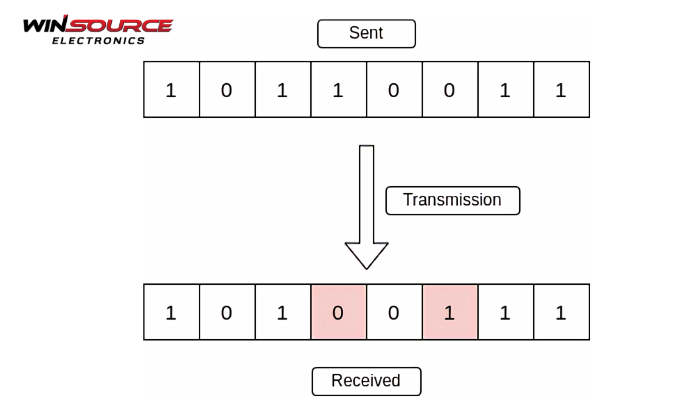
The performance of error detection refers to how effectively a system or algorithm can identify errors in transmitted or stored data. It is typically evaluated using several key metrics that indicate the accuracy, reliability, and efficiency of the error detection mechanism.
Key Metrics for Error Detection Performance:
Detection Rate (or Detection Efficiency):
The probability that an error is successfully detected.
A high detection rate means most errors, especially random or burst errors, are caught before data is used.
Example: A good CRC (Cyclic Redundancy Check) may detect over 99.999% of all single-bit, double-bit, and burst errors.
False Negative Rate:
The probability that an error occurs but is not detected.
This is critical in safety-critical systems (e.g., aviation, medical devices) where undetected errors can have serious consequences.
Ideally, this rate should be as close to zero as possible.
Overhead:
The amount of extra data (check bits) added for error detection (e.g., parity bit, CRC checksum).
Lower overhead is desirable, but it must be balanced against the required detection strength.
Processing Time / Latency:
How quickly the error detection logic can compute and verify checksums or codes.
In high-speed communication or real-time systems, low-latency detection is essential.
Burst Error Handling:
Some error detection codes (like CRC) are more effective at detecting burst errors (multiple adjacent bit errors), while others (like parity) may only detect single-bit issues.
Common Error Detection Methods and Their Performance:
Method | Detection Ability | Overhead | Use Case |
Parity Bit | Detects single-bit errors only | Very low | Simple memory or communication checks |
Checksums | Moderate detection (depends on sum) | Low | Network protocols (e.g., IP header) |
CRC | High detection of random and burst errors | Medium | Ethernet, USB, storage systems |
Hamming Code | Detects and corrects 1-bit errors | Moderate | RAM, ECC systems |
Hash Functions | Strong detection, no correction | High (complex) | File integrity, secure data checks |
Summary:
The performance of error detection depends on the method used and the application requirements. A good error detection system strikes a balance between:
- High detection rate
- Low false negatives
- Acceptable overhead and latency
For most modern systems, CRC algorithms offer excellent performance for both detection reliability and processing efficiency, making them the go-to choice in critical communication and storage applications.