Understanding the Mealy&Moore State Machine Model
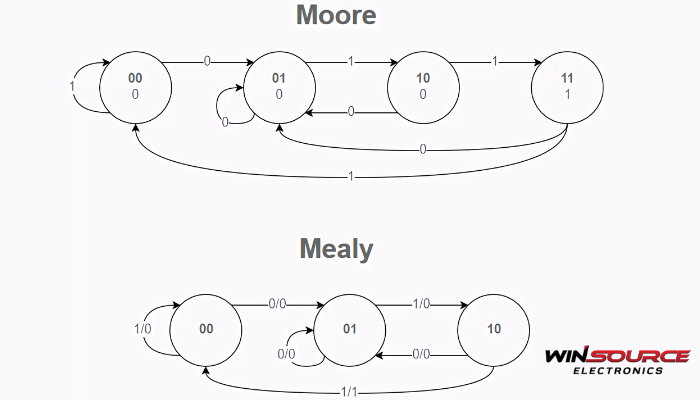
* Question

What is the difference between the Mealy state machine and the Moore state machine?

* Answer

The main difference between a Mealy state machine and a Moore state machine lies in how the outputs are generated in relation to the states and inputs:

Mealy State Machine:

  1. The output depends on both the current stateand the current inputs.
  2. This means the output can change immediately when the input changes, even within the same state.
  3. Generally more efficient in terms of the number of states because outputs can be influenced directly by inputs.

Example: If the machine is in state S1, and the input changes, the output might immediately change as well.

Moore State Machine:

  1. The output depends only on the current state.
  2. The output is updated only when the state transitions, not when the input changes (the output is fixed for each state).
  3. The design can be simpler, as there is a clear, direct relationship between the state and the output.

Example: In a Moore machine, regardless of the input, the output remains the same as long as the machine stays in the same state.

Summary:

  • Mealy Machine: Output depends on both state and input (more reactive to input changes).
  • Moore Machine: Output depends only on the state (more predictable, output changes only on state transitions).

The choice between the two typically depends on the specific design requirements, such as whether you need quicker responses to input changes (Mealy) or a simpler, more predictable design (Moore).

Frequently Asked Questions

Q: What is Understanding the Mealy&Moore State Machine Model?
A: Explore the Mealy&Moore State Machine and understand its unique features and applications in digital systems design.
Q: Which category does Understanding the Mealy&Moore State Machine Model belong to?
A: Understanding the Mealy&Moore State Machine Model is part of our QUESTIONS & ANSWERS collection, where we cover the latest trends and technical insights.
Q: Where can I find more technical details on QUESTIONS & ANSWERS?
A: You can explore our QUESTIONS & ANSWERS section for more articles and resources related to this topic.